
Masood Khan, Pakistan's Ambassador to China, said that a feasibility study of the railway had been conducted but there was still no time-table for starting the construction.

Wondeful shots of African women and giraffes roaming Kenyan grasslands were judged the most outstanding photographs of the year.
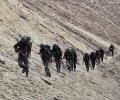
The government needs to answer the critical question of whether it has accepted any restrictions on its infrastructure creation activities, asserts Ajai Shukla.

Beijing's sky was gloomy and the ground largely deserted.

Sources said that even though India and China have been talking at the diplomatic and the military level for over six weeks now, there has been no thinning down in troop numbers or equipment by the Chinese side on this front.
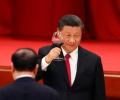
After the Ladakh fiasco where Xi Jinping did not expect the Indian Army to resist his land-grabbing tactics, he has to save face before his colleagues in the Communist party.' To bring the threat of a mega-dam to the northern Indian border is a clever move, observes Claude Arpi.
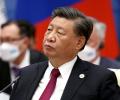
Xi Jinping's recent actions in South Asia have amply demonstrated the disastrous impact of China's embrace, observes Jayadeva Ranade, the retired senior RA&W officer and China expert.

'This was Indian land the PLA advanced on and occupied.' 'The Chinese then 'negotiated' a pullback of their troops a small distance on Indian territory even as Indian jawans draw back further into India from the forward position.' 'An apparently satisfied Indian government says this is a great move for peace! How great is that for China!'

General Zhao Zongqi is well known in India for having commanded the Chinese troops during the Dokalam episode. Zhao knows every inch and corner of the Indian border, at least the Eastern and Central sectors, including the Naku La area which witnessed fist-fights between Indian and Chinese troops in April/May. Claude Arpi introduces us to the PLA generals masterminding the Chinese aggression in Ladakh.
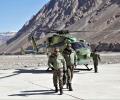
'This reluctance to respond forcefully to Chinese PLA provocations and outright aggression has as much to do with Prime Minister Modi personally, as with the institutional mindset of the MEA or even the Indian Army.' 'They are scarred by the 1962 War and are still cowed by China.'

'The military advantage the Indian Army had gained by the Special Frontier Force occupying the heights of the Rezang La-Rechin La ridge on the Kailash Range is lost without the PLA withdrawing to east of the Khurnak Fort line.'
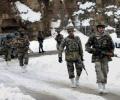
Within the army, there is growing concern that New Delhi will allow the Chinese to retain the territory they have occupied in the last month.

'A fragile Sri Lanka will have a serious impact on the security of India.'

'Islamic State has declared that the liberation of Islamic Xinjiang from China is an objective. Beijing may well find that Pakistan is unable to assist in any meaningful way,' says China expert Jayadeva Ranade.

The billions India invested in dams, schools, etc in Afghanistan will be gone. The Hindu and Sikh population of Afghanistan has already shrunk from some 200,000 to about 500, points out Rajeev Srinivasan.

'The Chinese are retaining geostrategic pressure on India by keeping troops there and building infrastructure continually.'

Rup Narayan Das reveals the towering Odisha leader's role in improving national security after the 1962 War with China.
With China hardening its stance on the Kashmir issue, India now should be rethinking on appropriate policy options on Tibet, Taiwan or even on Xinjiang, says China expert Srikanth Kondapalli.
The Pakistanis, since the days of General Pervez Musharraf, have repeatedly sought Chinese assistance for the construction of a petrochemical complex at Gwadar and oil and gas pipelines and a railway line connecting Gwadar with the Xinjiang province.
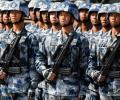
With the Indian Army having blocked the PLA several kilometres inside India, hundreds of soldiers from both sides remain in a tense face-off.
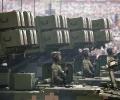
The first priority for the new Tibetan administration in Dharamsala should be to look at Tibetan recruitment in the PLA, suggests Claude Arpi.

'All the government needs to do is to identify clear political and strategic objectives and to give the military planners a free hand,' asserts Ajai Shukla.
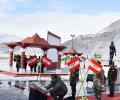
The Chinese authorities have been rapidly building defence infrastructure along the Line of Actual Control, indicating that they are preparing for a long period of tension with India, points out Jayadeva Ranade, the former senior RA&W officer and China expert.

China is scouring its territory in Tibet and Xinjiang for the Malaysian jetliner missing for 11 days, a senior diplomat said as international efforts to locate the plane failed to achieve any breakthrough.

Reliance's big-bang entry across the solar ecosystem will cut dependence on Chinese imports drastically. And Ambani's repeated emphasis that RIL's new energy foray will be 'a truly global business' points that his group is playing not just for a share of the Indian pie but to be the OEM in the larger 5,000 GW global market by 2030, points out Shailesh Dobhal.

'The threat of ceding space to China in Afghanistan appears to be one factor propelling our government to get a bit more active now.'

Indian Army officers are convinced China is maintaining the pretence of dialogue and negotiations in order to create the opportunity to occupy more Indian territory. Senior Indian planners apprehend this might be a Chinese ploy to divert attention from Depsang, in Northern Ladakh, which might be China's actual target.

With the two armies again in a face-off at multiple points, there is apprehension of renewed clashes.
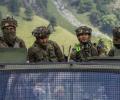
India and China on Saturday held another round of military talks with a focus on taking forward the disengagement process in Hot Springs, Gogra and Depsang in eastern Ladakh and bring down the tensions in the region, official sources said.

Until last month more than two-thirds of the Indian Army was deployed against Pakistan. Of 14 army corps, just four-and-a-half faced China, while more than twice that number was ranged against Pakistan.

The Tibetan nation still lives under the yoke of the Chinese Communist Party, and Beijing today has a guilty conscience; this creates a great uneasiness for Xi Jinping and his colleagues observes Claude Arpi.

China on Tuesday ruled out involvement of its nationals on board the missing aircraft in a hijack attempt, but launched search operation on its own territory in Tibet and Xinjiang after inputs that the Malaysian plane might have flown to Central Asia through the northern corridor.

India is apprehensive about the Taliban's return as it would mean loss of access to Baluch rebels and help to the restive tribals of Waziristan. This would be a setback to the Indian strategy of returning the compliments of death by a thousand cuts to Pakistan, notes Colonel Anil A Athale (retd).

When China protested strongly over the August decision on J&K -- not once but twice -- we ignored it. And to compound matters, we simply turned our back and walked over to the 'Quad' alliance with the US, upgrading it to ministerial level, and thereafter began following the American footfalls on Taiwan and COVID-19 to taunt and humiliate Beijing, observes Ambassador M K Bhadrakumar.

The US intends first to cripple the Afghan government financially through sanctions, freezing of assets, denial of access to international banking, etc, and then proceed to do pretty much what it wants to do with scant regard for Afghanistan's sovereignty, predicts Ambassador M K Bhadrakumar.
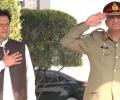
'The Modi government's grandstanding has hardened the reflexes in Beijing, Islamabad and Kathmandu and complicated India's relations with these three countries, which were even otherwise highly problematic.' 'Whatever prospects existed for a fair and balanced resolution of the territorial disputes may also have receded,' observes Ambassador M K Bhadrakumar.

Sources indicated that during Saturday's talks, India will insist on a faster disengagement process in remaining areas to bring down tension in the region, which has witnessed a tense standoff between the two militaries for over nine months.

China on Wednesday said no trace of the missing Malaysian plane entering its territory or airspace has been found after scouring the most difficult terrain in Tibet and Xinjiang.
'The Indian Army's surveillance had noticed the Chinese movements.' 'There was no intelligence failure.'
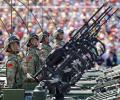
The move took place late last month and involved hardware being moved simultaneously by road and rail from across the entire region.
 © 2026 Rediff.com - Advertise with us - Disclaimer - Privacy Policy - Sitemap - Feedback - About us - Terms of use - Grievances